Drone Roof Inspection
Drone Roof Inspection
A roof looked at properly, close up, with nothing leaned against the gutter and nothing built up against the wall.
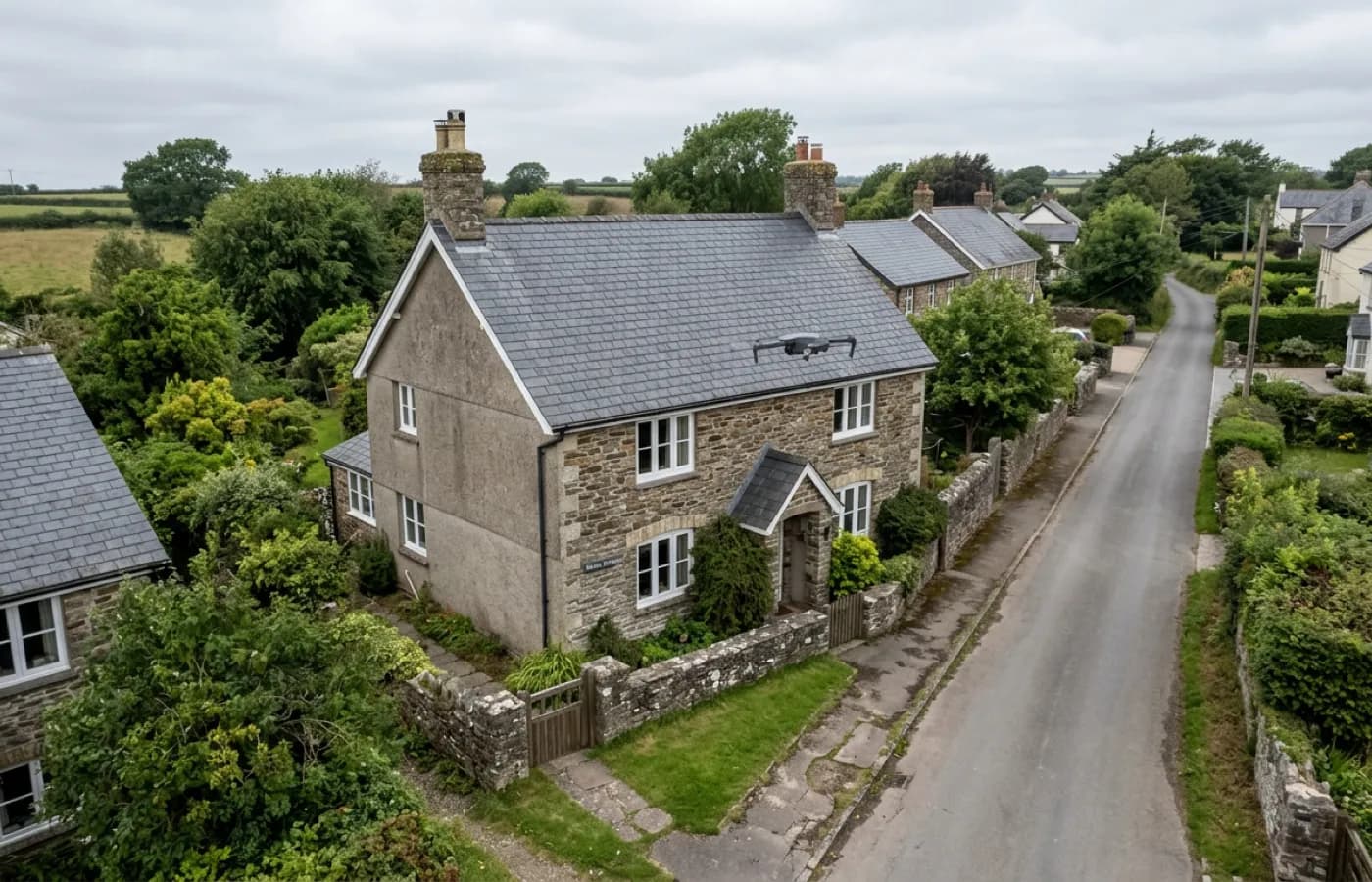
Most roof problems start the same way: somebody notices a stain, a missing slate seen from next door's upstairs window, or a builder mentions it in passing while quoting for something else. The next step has always been the awkward one. Getting a person safely up there means a ladder against a gutter that was never designed to take the weight, or a tower that needs a van, a base built up on level ground, and a day either side for putting it up and taking it down.
A drone inspection skips that step entirely. The aircraft gets in close enough to read the same detail a person standing on the roof would see, without a ladder touching the fascia, without a base plate on the lawn, and without anybody working at height on your property.
What you get afterwards is not just a look. It is a written record of what was found, where it is, and how urgent it looks, sent to your inbox within 48 hours with the full resolution images alongside it.
What is included
- Every roof slope covered from a safe standoff distance
- Close detail on ridges, valleys, verges and abutments
- Chimney stacks, pots, flaunching and flashings
- Gutters, downpipes and the junctions where they meet the roof
- A written report within 48 hours with annotated images
- Full resolution originals so a roofer can zoom in themselves
- Nothing put up against the building at any point
What working without contact actually removes
A scaffold tower is not simply expensive, it is a project. Somebody has to survey the ground it stands on, level a base plate, sometimes apply for a pavement licence if it stands on the public footway, and then live with it for however many days the job takes. A ladder is quicker to arrange but limits what can actually be reached and inspected safely, particularly on a two-storey house with a steep pitch or a gutter that will not take a ladder's weight.
None of that is needed here. The aircraft holds a standoff distance from the building throughout, so there is no equipment on the ground, nothing braced against a wall, and no need to establish whether the lawn or the driveway can take the weight of a base plate. For a rented property or a shared driveway, that also means no access negotiation with anyone else who uses the space.
It changes the economics of finding out. Instead of committing to the cost of a tower before anyone has confirmed there is a problem worth that cost, the inspection happens first and the decision about what, if anything, needs doing gets made from a report rather than a guess from the pavement.
Where this suits a difficult building or a difficult street
Plenty of Devon and Cornwall properties make a physical inspection harder than it should be before anyone even gets to the roof. Narrow streets in a historic town centre where a scaffold lorry cannot park close enough. Listed buildings where fixing a tower against the wall means a conversation with the conservation officer before anything else happens. Steep hillside plots where a base needs levelling and bracing before it is safe to climb. Terraces where the only access is through a neighbour's garden.
A drone inspection does not care which of those applies. It launches from wherever is lawful nearby and reaches the roof the same way regardless of what the street or the plot looks like underneath it, which is the specific problem this service is built to solve.
On the day
How a homeowner inspection runs
- Step 1
Tell us about the house
The address, roughly what has been noticed, and anything about the street or the plot that might affect where the aircraft can take off from. Most of this the surveyor works out from a map before arriving.
- Step 2
A short look round first
A few minutes at ground level. Where downpipes discharge, what the render is doing lower down, which room a stain has appeared in. It usually points the camera in the right direction before it has even taken off.
- Step 3
The flight
The aircraft works round each elevation from a standoff distance, then moves in close on anything worth a second look. Half an hour to an hour on a typical house. Nothing touches the building at any stage.
- Step 4
The report
Images sorted, findings written up in plain terms, a note on urgency against each one. In the inbox within 48 hours, with the originals attached so nobody has to take the description on trust.
Behind the work
Kit, cover and qualifications
Nothing put up against the house
No scaffold tower, no ladder against the gutter, no base plate on the drive. The aircraft holds a standoff distance from the building for the whole inspection.
CAA registered
Operator ID and Flyer ID held, plus the A2 Certificate of Competency, which is what allows the closer operation near buildings and streets that makes this work in a terrace or a town centre.
100 megapixel camera
A DJI Mavic 4 Pro with a Hasselblad camera and 6K video. The resolution is what lets the aircraft stay at a safe distance and still return detail close to what a person standing on the roof would see.
Insured with Coverdrone
Full commercial cover for the operation. Certificates go to managing agents, block committees and insurers as a matter of course, without anyone having to chase for them.
Homeowner inspection
Drone Roof Inspection questions
- Can this cover just one part of the roof, like a chimney?
- Yes, and it is a common request when somebody already suspects roughly where the problem is. It is usually worth covering the rest of the roof while the aircraft is up, since the fault that shows up as a stain is not always the one that was suspected.
- What if there is nowhere to put a scaffold up anyway?
- That is exactly the case this service is built around. A narrow street, a shared driveway, a steep plot or a listed building that cannot take fixings all stop a tower going up before the roof has even been looked at. None of them stop the aircraft.
- Do you need access to my garden or roof space?
- The aircraft needs a lawful, clear space nearby to take off and land, which is usually the drive or the street outside. Nobody needs to go into the loft or onto the roof for this inspection.
Where
Drone Roof Inspection across the South West
Also on this site
See how it works
Book an inspection with Drone Roof Inspection
Tell us the address and what you need looking at. Sam Hembury will come back with a fixed price and the next available slot.