Start to finish
An hour on site, a report two days later, and nothing put up against the house
On the day
What happens on the day
- Step 1
The access check before the visit
This is the step that replaces the scaffold survey. Rather than checking whether a tower can be built or a ladder can be safely footed, the check is simpler: is there a lawful, clear space nearby to take off and land, and is the address inside any airspace restriction. Both get settled before a date is confirmed.
- Step 2
Ten minutes on the ground
A walk round first. Where the downpipes discharge, what the ground floor is telling you, and anything already noticed inside. It is surprising how often this points the camera in the right direction before anything is in the air.
- Step 3
The flight
A systematic pass round each elevation for the overview frames, then close work on ridges, valleys, abutments and stacks, all from a standoff distance that never puts the aircraft in contact with the building. Half an hour to an hour for a typical house.
- Step 4
The screen check
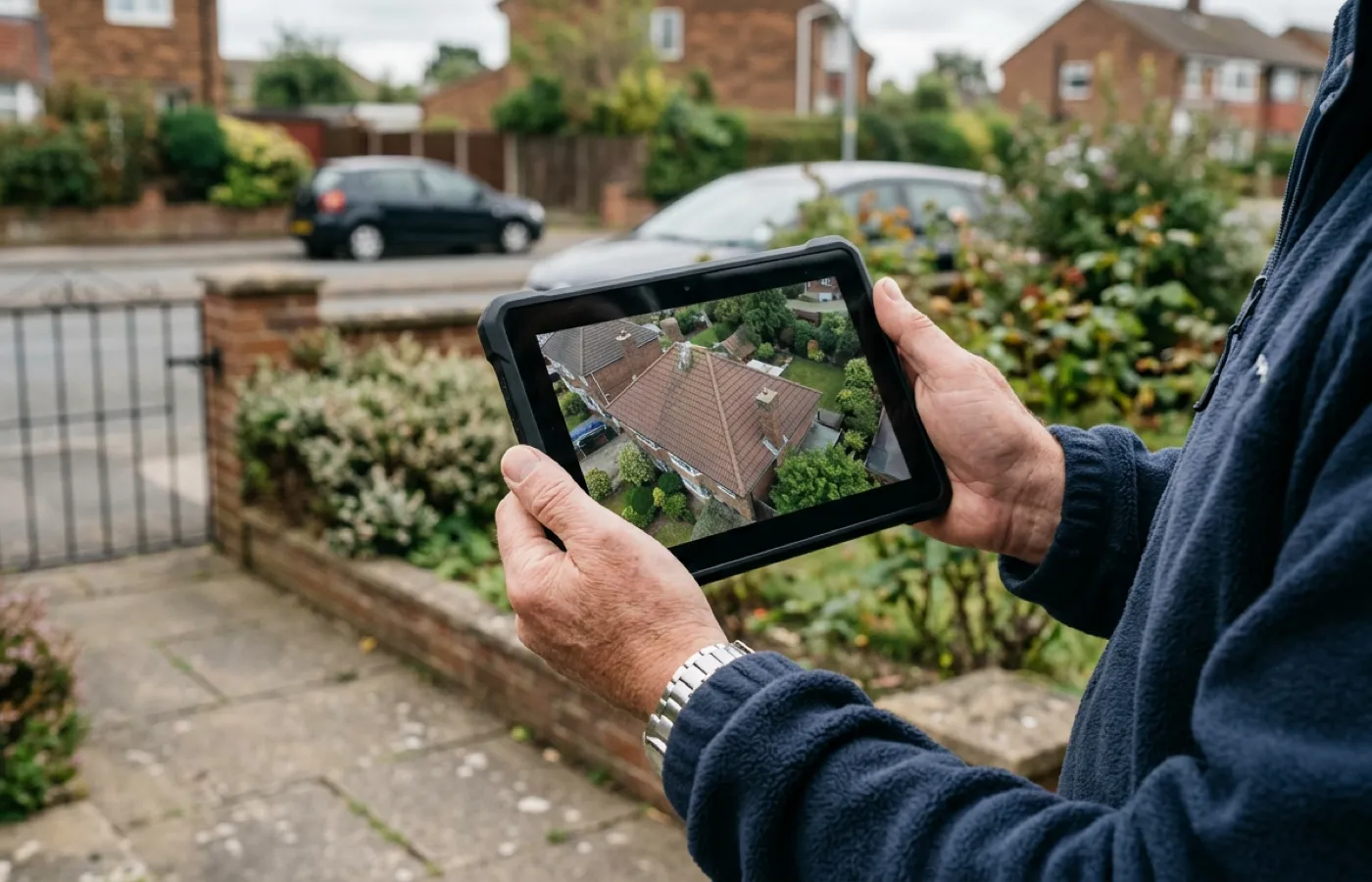
Before packing up, the imagery gets reviewed on site. If an angle was missed or something is unclear, it gets reflown there and then, rather than discovered back at the desk two days later.
- Step 5
The desk work
Images sorted by elevation, anything found identified and marked up, and each item written up with a note on urgency. This is the part that takes the time and the part actually being paid for.
- Step 6
The report lands
Within 48 hours of the flight, by email, with the full resolution originals alongside it. If anything in it needs explaining, ring and it gets explained.
The report
What is in the report
Elevation overviews
One clean frame per slope, so the roof can be understood as a whole before anyone starts looking at individual items.
Marked up detail images
Every item found, photographed close and marked so there is no argument about which slate, joint or gutter run is being discussed.
Plain descriptions
What it is, where it is, and what it is likely to lead to. Written in words a homeowner can follow and a roofer will not roll their eyes at.
A view on urgency
Whether something wants doing now, at the next opportunity, or watching. Not a price, because pricing the repair is the roofer's job.
What could not be seen
Anything obscured by vegetation, standing water or an adjoining building is listed as not assessed rather than quietly left out.
The original files
Full resolution images, so whoever quotes the work can zoom in for themselves rather than trusting a compressed screenshot.
Why 48 hours
Because that is how long the desk work takes when it is done properly, and because a report that arrives a fortnight later has usually stopped being useful. If an inspection is tied to a deadline, an insurance query or a change of tenant, say so when you book and it gets scheduled around it.
Weather and rules
The bits that decide whether a flight happens
Access
Somewhere lawful, clear and reasonably close to the building to take off and land. On most streets and drives this is straightforward; on a properly awkward site it gets settled by phone before a date is agreed, not on arrival.
Wind
Above roughly 20 miles an hour the aircraft is working hard enough that image stability suffers, and gusts around a building are worse than the forecast suggests. An inspection flown in marginal wind produces marginal imagery, so it moves instead.
Rain
Water on the lens ruins the frame and water on the roof hides exactly what you are looking for. Damp after rain is workable. Actual rain is not.
Light
Bright overcast is the best light there is for this work. Hard low sun throws deep shadow into valleys and behind stacks, which is precisely where the problems live.
Airspace
Some addresses sit inside a flight restriction zone around an aerodrome or under other restricted airspace. That is checked before booking. Where a flight cannot happen at all, you are told before you have paid anything.
What is underneath and around
The A2 Certificate of Competency allows closer operation near buildings and uninvolved people than the basic category, which is what makes a tight street or a terrace workable. It still means thinking about a school playing field next door or a busy pavement below.
Before you book
Common questions
- Is this actually as thorough as someone standing on the roof?
- The aircraft covers every slope, ridge, valley and stack from close enough to read the same detail a person on the roof would see, and the 100 megapixel camera means individual images can be cropped into afterwards. What it cannot do is lift a tile or feel for a soft spot underfoot, and the report says plainly where something would need physical access to confirm.
- Why not just put up a ladder, it is quicker to arrange?
- A ladder reaches the eaves and sometimes a lower valley, but it does not reach a ridge, a far slope, or a stack safely on most houses, and it depends on a gutter or fascia taking weight it was never designed for. Most of what actually fails on a roof, the ridge, the valleys, the flashings, is exactly what a ladder from the ground cannot reach.
- What if my street or drive has nowhere obvious to launch from?
- This gets checked before the visit is booked, not on the day. Most residential streets and drives are workable, and where one is not, that gets flagged early enough to find an alternative rather than turning up and finding out.
- Do I need to be home?
- No. Plenty of inspections are flown for owners who live elsewhere, or for landlords and agents with no need for anyone on site. Somewhere lawful nearby to take off and land, and permission to be there, is all that is required.
- How is this different from a normal roof survey?
- The inspection and the survey use the same aircraft and the same report format. The difference this site is built around is access: the whole point here is what does not have to happen to the building or the street beforehand, for anyone whose roof or plot makes a scaffold or a ladder job properly awkward.
- What if the weather is bad on the day?
- The flight moves. Wind and rain both ruin the imagery, so a visit in poor conditions gets rescheduled rather than flown badly. This costs nothing and is treated as normal rather than a cancellation.
- What do I get at the end?
- A written report within 48 hours, with annotated photographs, an overview of each elevation, a note on how urgent anything found looks, and the full resolution images so a roofer can zoom in for themselves.
- How much does an inspection cost?
- It is a fixed price agreed before the visit, based on the address and the size of the roof. Send the address and what needs looking at, and the figure comes back rather than a range.
See how it works
Book an inspection with Drone Roof Inspection
Tell us the address and what you need looking at. Sam Hembury will come back with a fixed price and the next available slot.